
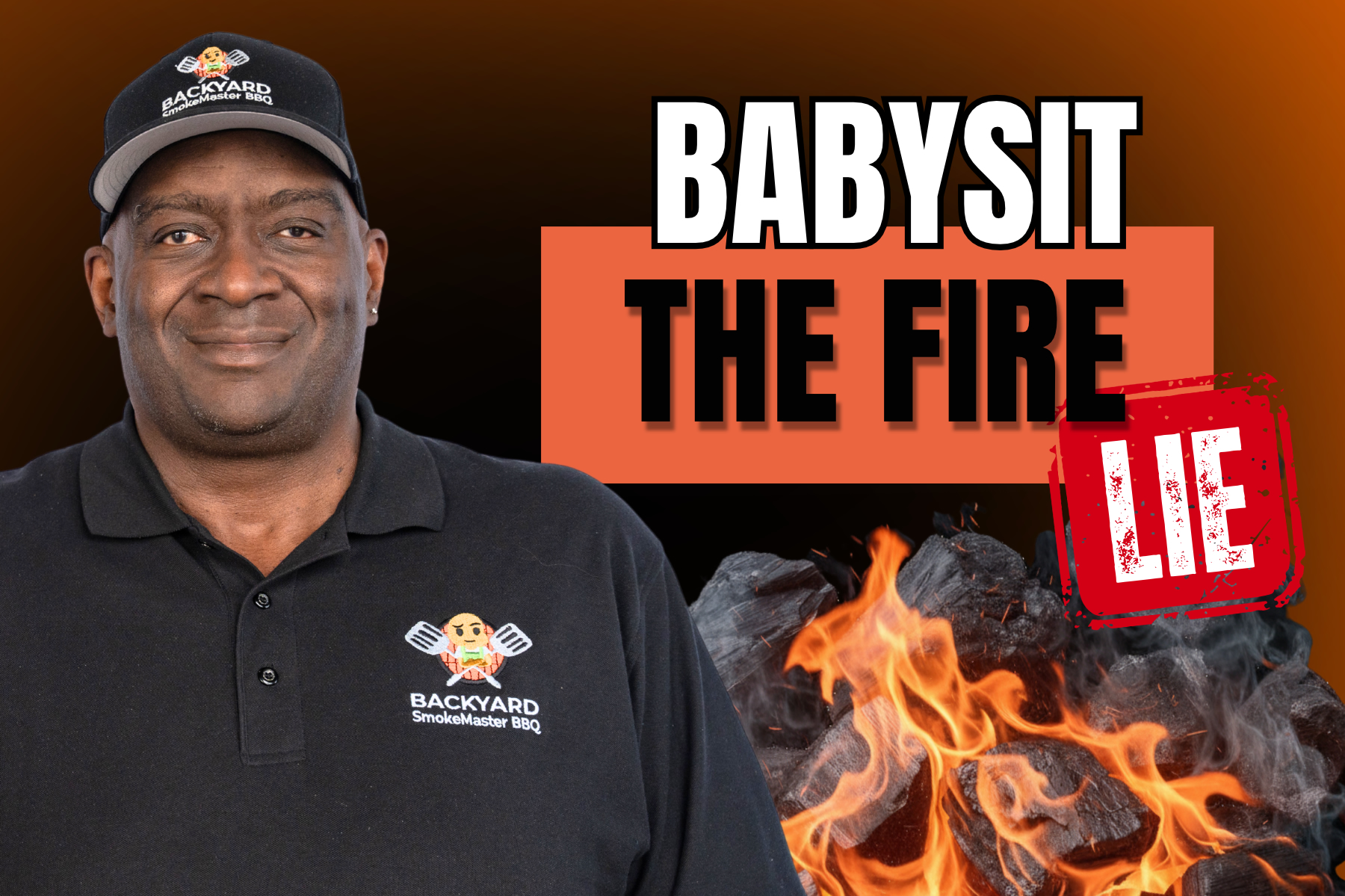
Raise your hand if you’ve been the person chained to the grill all day while everybody else is in the pool: lifting the lid every five minutes, poking the coals, glued to the temperature gauge. A lot of us believe that if we’re not standing there adjusting and feeding the fire, the whole cook falls apart. Episode 117 takes that apart. A fire that’s built right does most of the work for you, and all that hovering is often the very thing that’s wrecking the cook.
Where the babysitting habit comes from
Most of us learned to barbecue on a cheap grill with no real airflow control, where the fire really did swing wild. So we trained ourselves to hover. That was a survival reflex, not a skill. Real fire management is setup and patience, not constant intervention. The goal is to earn the right to walk away.
Build a two-zone fire
This is the foundation. Bank your coals to one side for a hot, direct zone, and leave the other side empty for a cool, indirect zone.
With two zones, you stop managing the fire minute to minute and start managing where the food sits. If it’s cooking too fast, slide it to the cool side. If it needs color, bring it back over the coals. A one-zone fire, with coals spread across the whole grill, means you’re always reacting. A two-zone fire means you planned for the problem before it happened.
It works on a kettle, a barrel and most other cookers, and you don’t need fancy gear to do it.
Pick the fuel that matches your day
This isn’t about which charcoal is better. It’s about which one matches the day you want to have.
- Lump charcoal is real wood charred down to carbon. It lights fast, burns hot and responds quickly to airflow. The pieces aren’t uniform, so it burns less predictably and can burn through faster, which means a long cook can need more of your attention.
- Briquettes are made to be uniform. They burn steady and even for a long time at a stable temperature. The trade-off is that they’re slower to respond when you want to raise the heat quickly.
If you’re hosting all day and want to disappear into the party, lean predictable and use briquettes. If you’re doing a fast, hands-on sear with the family gathered around, lump rewards that. Match the fuel to the day, not to the argument online.
Set the vents, don’t chase them
On a kettle, the bottom intake vent sets the baseline. At the start of the cook, open it to match the amount of air and heat you want, then leave it there. Do your temperature control at the top vent, with small moves.
The discipline that changes everything: make one small adjustment, then wait 10 to 15 minutes before you touch anything again. A cooker has lag. It’s more like steering a boat than a sports car.
Here’s why hovering backfires. When you adjust again before the last change has settled, you’re chasing the temperature. You overshoot, panic, slam it the other way and overshoot again. The temperature swing you’re fighting is the one you created.
Offsets are the exception. On an offset smoker, keep the smokestack fully open so the smoke stays clean, and manage your heat at the firebox intake. If you choke the stack, stale smoke sits in the cook chamber and lands on your food. An offset also needs more of your attention than other cookers, because every split and every fire is different.
Normal is a range, not a number
A cooker holding inside a 15 to 20 degree window is a healthy fire, not a problem. If I want 250°F, I’m fine anywhere between 225 and 275°F, especially on an offset, because it’s likely to average out close to 250. You’re cooking with a live fire, and the outside temperature and the wind both play a part. Don’t start making a string of adjustments to pin one exact number.
Keep the lid down
Every look inside is heat lost, and that adds time on the back end of the cook. Opening and closing the lid also swings the temperature. Sometimes the fire spikes after you close it, because you just fed it a rush of air. A probe thermometer takes away most of the reason to look: if you know the internal temperature of the meat and the temperature inside the cooker, there isn’t much left to check.
Two zones on an offset
Grace Day by Day asked how two-zone cooking works on an offset. The firebox end runs hotter than the far end, so you already have two zones. If the point of your brisket is cooking slower than the flat, turn the brisket so the point faces the firebox. If you’re cooking chicken and baby back ribs together, put the chicken closer to the firebox so it cooks hotter, and the ribs farther away for low and slow.
The payoff
Once the fire is dialed in, you’re free. You can be in the pool or at the table with the people you’re cooking for, which is the reason we do this. Make it a family affair, too. Give the kids safe, real jobs, like reading the temperature gauge and handing you tools, so they learn to respect the fire from a safe distance. And if you’re a nervous cook, remember that a fire you set up right forgives you. You don’t have to be perfect.
More from the chat
- Poll: asked how often you open the lid mid-cook, 79% said only when I have to, 11% said every 30 to 45 minutes, 5% said every few minutes, and 5% said I set a timer and walk away.
- Burgers indirect. Mama Micah gives her burgers about 15 minutes on the cool side, then sears to finish, so she doesn’t end up with a burnt outside and an underdone center. Smiling Family sears first, then moves them to indirect once the crust looks good.
- Use the cool side for the finish. Toast buttered buns there, or move the patties over and melt the cheese without burning it.
- Learn your cooker’s lag. Smiling Family’s tip: many thermometer apps graph temperature over time. Note the clock when you adjust a vent, then use the graph to see how many minutes your cooker takes to settle.
- Fan controllers. Kettlemania and Mama Micah both use a fan-driven temperature controller for low and slow cooks. For higher temperatures, Jeff found you need to light more charcoal at the start. That matched my experience.
- Check for air leaks. Why Not Grill pointed out that leaks between the base and the lid make temperature harder to control. On a ceramic cooker, that can mean it’s time to replace the gasket.
- Drum smokers. Start with the bottom intake wide open. As you come up on your temperature, close the intake partway, then make your small adjustments at the exhaust on top and give each one 10 to 15 minutes.
- “Burns hotter and longer.” Why Not Grill asked what a bag of charcoal is being compared with when it says that. As far as I can tell, the bag doesn’t say.
- Fire safety. Correctional Officer reminded everybody to be careful grilling on a wooden deck and to keep a fire extinguisher close.
The recap
- Build it right. A two-zone fire is what buys your freedom.
- Pick the fuel that matches your day: briquettes for a long, steady cook, lump for a fast, hot one.
- Set your vents, make one small adjustment at a time, and wait 10 to 15 minutes. Patience is the skill.
- A 15 to 20 degree swing is normal. Don’t chase a number.
- Keep the lid down and let a probe do the looking.
Keep the conversation going
Post your next cook in the Backyard SmokeMaster Society and tell us how your fire held: what cooker you used, how you set it up and how often you had to touch it. It’s free to join.
If this episode helped, share it with the friend who babysits the fire a little too hard. If you missed the live show, the replay is up on YouTube, and the audio version is available on your favorite podcast app.
Podcast: Play in new window | Download


Leave a Comment