
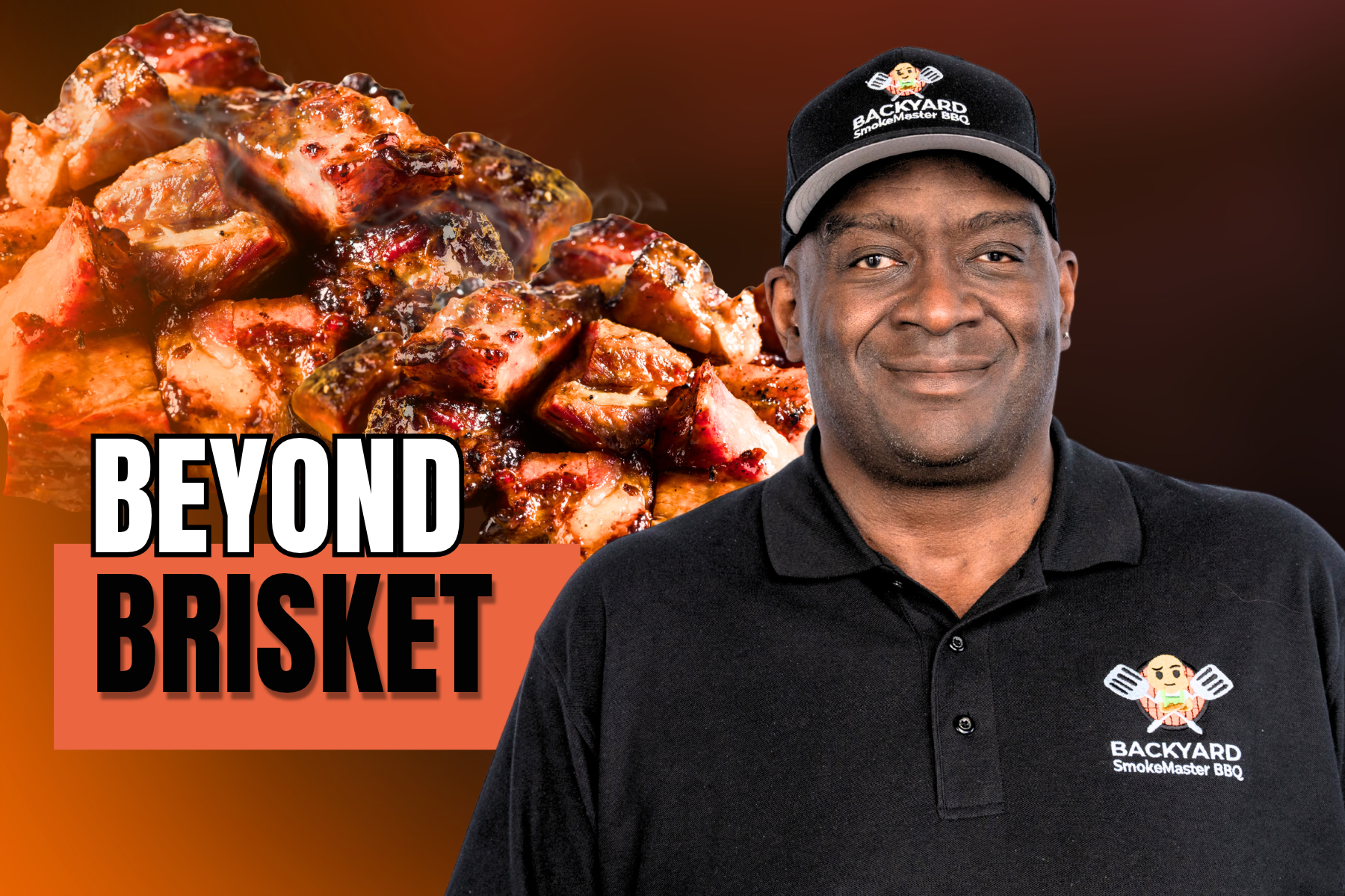
Brisket, ribs, chicken. That’s the rotation for most backyard cooks, and it was mine for years. There’s nothing wrong with it. Done right, those three will make you a legend in your own backyard. But they’re the starting line, not the ceiling. A newer wave of pitmasters stopped asking what’s on the menu and started asking what else can go on the smoker: beef cheeks, pork belly burnt ends, lamb shoulder, even cauliflower as the main event. Episode 115 covers the cuts, temperatures, times and methods so you can cook them at home.
This topic came from the Backyard SmokeMaster Society. Aaron pitched it, and Real Meatstick helped break down what people mean when they say new school barbecue.
What is new school barbecue?
New school barbecue treats barbecue as a method, not a menu. LeRoy and Lewis in Austin is the name that comes up most, and Evan LeRoy’s recent cookbook has helped bring the idea into the mainstream. It doesn’t throw out tradition. You keep everything you already know and add to it. It comes down to three ideas:
- Use the whole animal, not only the usual cuts.
- Flavors have no borders. Borrow from everywhere.
- Vegetables can be the headliner. They don’t have to ride shotgun.
Cut 1: Beef cheeks
Many people consider beef cheeks the signature new school cut. The cheek is a hard-working muscle, so it’s loaded with collagen. Think of it as a mini brisket, with only two per steer. The best part is the clock. A brisket can take 10 to 14 hours or more to get tender, and beef cheeks are done in about five to six.
- Smoker temperature: 250°F to 275°F.
- Trim: take off the heavy silver skin, and stop there. There isn’t much meat to spare.
- Cook: smoke until you have a deep, dark bark. From there, let them ride unwrapped, or put them in an aluminum pan with a little tallow or beef stock to push them through.
- Done: 200°F to 210°F internal, but the real test is probe tenderness. The probe should slide in like it’s going into soft butter.
- Serve: slice across the grain, or shred them for barbacoa tacos.
Cut 2: Pork belly burnt ends
If beef cheeks are the signature cut, pork belly burnt ends are the gateway. They’re sweet, sticky and rich, and I call them meat candy. This is probably the most familiar cut on the list.
- Prep: cube the belly into 1½ to 2 inch pieces and season them.
- Smoke: at 250°F for about two and a half to three hours to build color.
- Braise: move the cubes to an aluminum pan with butter, brown sugar and a little sauce. Cover and let them braise until they reach about 200°F to 203°F internal.
- Glaze: pour your favorite barbecue sauce over the top and give them about 15 more minutes to set.
A safety note: pork belly throws off a lot of grease. Keep it draining away from your fire, and if you can, set a pan underneath to catch it. Pooled fat and a flame is how grease fires start.
Cut 3: Smoked lamb shoulder
This is the one Aaron had in mind. Lamb shoulder doesn’t show up much in American barbecue, and I don’t cook much lamb myself, so it’s one I need to explore. The trick is to treat it like a pork butt, and you end up with rich, pull-apart lamb.
- Smoker temperature: 250°F, fat side up.
- Wrap: when the bark sets, usually around 165°F to 170°F internal, wrap it to push through the stall.
- Done: 195°F to 205°F and probe tender. Plan on six to eight hours.
- Rest: about 30 minutes, then pull it.
- Flavor: lamb goes well with rosemary and garlic, or a bright chimichurri.
On the wrap, I’m in the butcher paper camp. It breathes, so it protects the bark while the meat keeps climbing. A tight foil wrap will get you there a little faster, but I think it steams the meat and softens the bark. Why Not Grill 55 splits the difference: butcher paper to get through the stall, then foil for the rest. The Correctional Officer prefers paper but usually uses foil because of the cost. My tip is to buy one big roll. A big roll lasts me years.
Cut 4: Cauliflower burnt ends
This is the vegetable headliner, and it’s a dish LeRoy and Lewis is known for.
- Smoker temperature: 250°F to 275°F.
- Prep: trim the base so the pieces sit flat, and coat them in a little olive oil so the rub has something to hold on to.
- Season: use the sweet and savory rub you’d put on burnt ends. Cauliflower is mild, so go a little heavy.
- Cook: smoke until fork tender with a crisp, charred outside. That can take anywhere from 45 minutes to a couple of hours.
- Finish: toss in sauce for the burnt end treatment, or eat it as is.
Cauliflower is a good ride-along. It can go on the smoker next to whatever meat you already have going. The Correctional Officer asked whether wood chunks affect the taste. They do, so use wood in moderation. In my experience mesquite overpowers vegetables quickly, so I’d stick with a fruit wood like apple or cherry.
The chat was sold. Mama Micah wants to make it for her sisters-in-law who don’t eat much meat, Mike and Awesome Tatum both said they’d try it, and Smiling Family posted a cauliflower recipe in the Society.
Flavors have no borders
You use the same smoke skills you already have and plug in a different flavor system. A few to explore:
- Al pastor: the Mexican dish of marinated pork cooked on a spit.
- Korean galbi: marinated grilled ribs.
- Jamaican jerk: a cooking style and seasoning built on Scotch bonnet peppers, allspice and fresh thyme. Scotch bonnets are very hot, so start small.
- Barbacoa: a traditional Mexican method where beef, lamb or goat is slow cooked over an open fire or in an underground pit.
There’s a whole world beyond Texas salt and pepper and Kansas City sweet.
The nose-to-tail bonus round
- Beef tongue: I see it at my warehouse club all the time and haven’t tried it yet. The method I’ve been told works is to smoke it low and slow until tender, then peel and slice it. It’s popular for tacos.
- Oxtail: rich and full of gelatin. Smoke it for flavor, then braise it low and slow until it’s fall-off-the-bone tender. My first try came up short because I followed a recipe’s time to the letter and stopped braising too early. Keep going until it’s tender.
- Tri-tip: a West Coast staple that’s hard to find in other parts of the country, as Mama Micah confirmed from Virginia. Treat it like a steak, not a brisket. Smoke it to your target temperature, such as 130°F to 135°F for medium rare, and slice it against the grain.
- Smoked bologna: some call it Oklahoma prime rib. Buy a whole chub, score it, smoke it for a few hours and slice it thick. It’s inexpensive and fun, and it surprises people.
- Beef shank: Why Not Grill 55 asked about the cut sold as Thor’s hammer. I haven’t smoked one. I’d approach it like oxtail: low and slow for smoke and color, then braise it in a pan with beef stock until it’s very tender.
The method is the same one you already use. On a brisket or pork butt, you build bark, decide how to get through the stall, and cook until the meat is tender. Apply that to a new cut and you’ll be in good shape.
More from the chat
- Season ribs overnight or right before? The Correctional Officer’s wife asked. It depends on the cut. Pork ribs are thin, so they don’t need much lead time. Seasoning them while the smoker comes up to temperature is enough. Mama Micah finds pork ribs can take on a ham-like texture when they’re salted too early. Thick cuts like brisket and big roasts benefit from salting the night before.
- Does fish need to be wrapped in foil? No. Fish cooks fast and there’s no stall. I take it off around 140°F to 145°F internal, and the USDA guideline is 145°F. Past that it dries out.
- Goat and lamb: Smiling Family got started with lamb racks sliced into one or two bone lollipops, and recommends curry goat. The Correctional Officer says both are delicious.
- Barbecue sauce: Awesome Tatum asked for favorites. Mine is Blues Hog Original, and their Champions’ Blend is excellent too.
- Smoked cheese: The Correctional Officer asked where it fits. That’s cold smoking, where the goal is keeping the temperature low enough that the cheese doesn’t melt. It deserves its own episode.
- Which kamado? Kurt is choosing between a Weber Summit Kamado, a Big Green Egg and a Primo, and he has cooked on a Weber kettle. All three are solid and versatile. I’d lean toward the Summit Kamado, because it runs like a kettle and is easier to move without the risk of cracking a ceramic shell. Kevin owns two Big Green Eggs and would pick that. Whatever you choose, don’t light it with lighter fluid.
- Poll: pork belly burnt ends led at 58%, beef cheeks and lamb shoulder had 17% each, and cauliflower burnt ends had 8%.
The recap
- New school barbecue is a method, not a menu.
- Beef cheeks: 250°F to 275°F, five to six hours, probe tender at 200°F to 210°F.
- Pork belly burnt ends: smoke at 250°F for about three hours, braise to about 200°F, then glaze.
- Lamb shoulder: cook it like a pork butt, 250°F for six to eight hours.
- Cauliflower burnt ends: 250°F to 275°F until fork tender.
- Go by tenderness, not the number on the thermometer.
Keep the conversation going
Which cut are you trying first? Post your cook in the Backyard SmokeMaster Society, with pictures, what worked and what you’d change. It’s free to join, and it’s where topics like this one get started.
If this episode helped, share it with a friend whose smoker only knows three meats. If you missed the live show, the replay is up on YouTube, and the audio version is available on your favorite podcast app.
Podcast: Play in new window | Download

Leave a Comment