
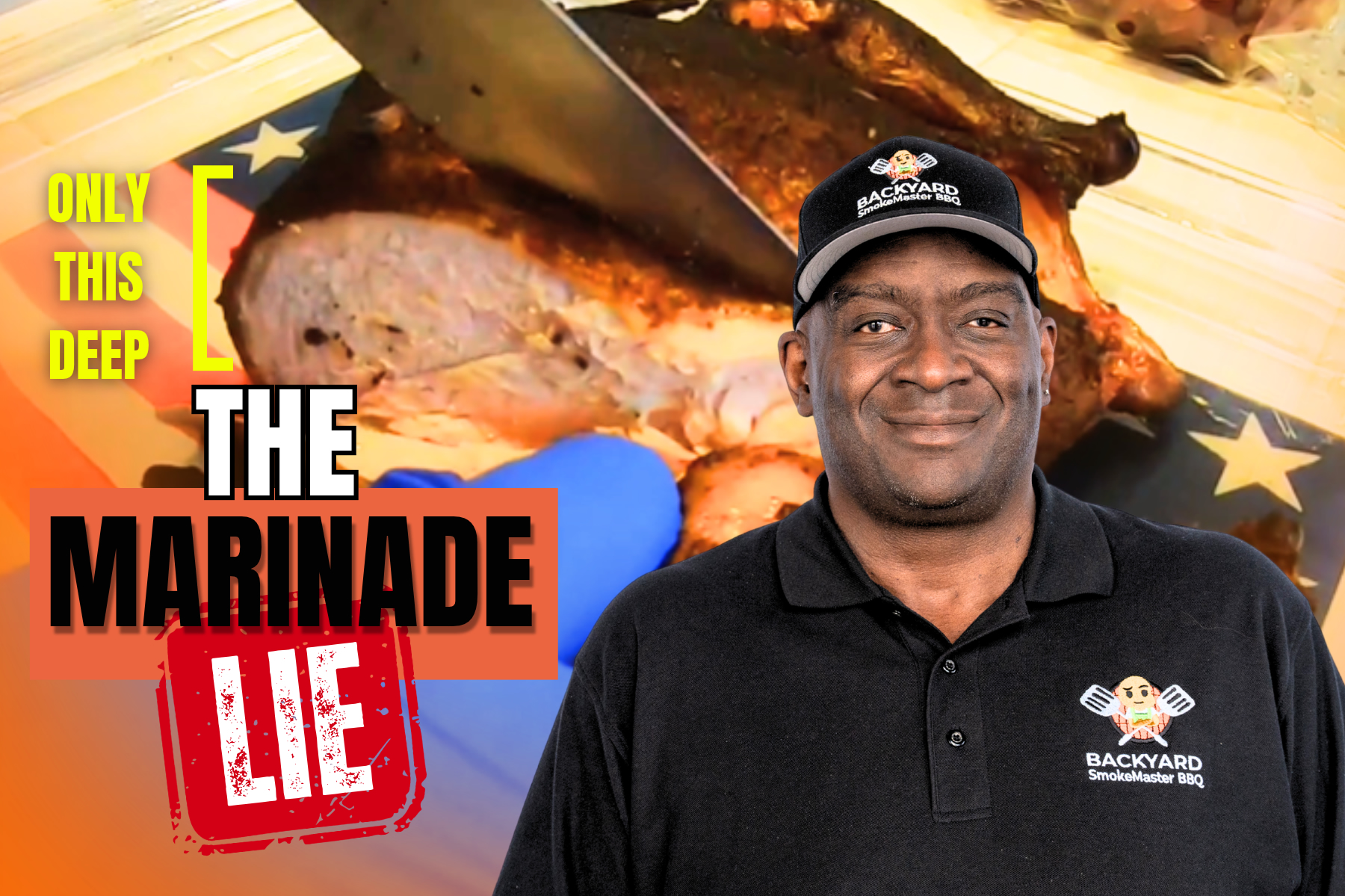
Be honest, you’ve done this. You drop a few chicken breasts in a zip-top bag, pour in the marinade, squeeze out the air and leave it in the fridge overnight, because the longer it sits, the deeper the flavor goes. Then you cook it, cut one open, and the flavor stops a couple of millimeters in. Past that, it’s plain chicken. The marinade never went deep, because physically it can’t. That doesn’t mean marinade is broken. It means we’ve been giving it the wrong job. Episode 114 covers the three ways to get flavor and moisture into meat, which are marinade, brine and injection, and which one to reach for on your next cook.
This topic came straight from the Backyard SmokeMaster Society. Thank you to Mama Micah for suggesting it, Smiling Family for the reminder, and The Correctional Officer for adding marinating to the mix.
Three methods, three depths
- Marinade flavors the outside. It only reaches a few millimeters into the meat.
- Brine works through the whole cut. Salt diffuses all the way in, so seasoning and moisture retention reach the center.
- Injection goes straight to the core of large cuts.
Before every cook, ask two questions. How deep do I need to go? And what’s my goal: flavor, moisture or both? The answer depends on how much of the meat sits near the surface and how long the cook is. Steaks, kebabs and fish are short, hot cooks. Pork butts, big roasts and briskets are long ones.
Marinade: flavor on the surface
A marinade is usually built from a few components, and each one does something different:
- Acid (vinegar, citrus, wine, buttermilk): changes the proteins at the surface and adds tang.
- Enzymes (pineapple, papaya, kiwi, ginger): break down proteins aggressively.
- Salt: acts like a mini brine on the surface.
- Oil: carries the flavors that dissolve in fat, not water. It’s what pulls flavor out of herbs and spices and carries it onto the meat, and it helps with browning.
- Sugar: caramelization and surface color.
- Aromatics: garlic, herbs and spices.
Here’s the reality. A marinade penetrates about two to four millimeters. A longer soak doesn’t go deeper. Past a few hours, you’re only stacking flavor on the surface, and too much time in acid or enzymes can leave the outside mushy or mealy. Pineapple, kiwi and papaya can break meat down badly within hours.
That makes marinade the right tool for foods with a lot of surface and a short cook: skirt steak, flank steak, chicken thighs and pieces, kebabs, vegetables and fish.
How long to marinate
- Fish: 15 to 30 minutes, maximum. Acid changes the proteins in fish the same way heat does, so the flesh turns opaque and firm in the bag. Leave it too long and the texture can go mushy or chalky before it ever reaches the grill.
- Vegetables: 30 minutes to a few hours.
- Chicken: two to four hours.
- Beef (thin cuts like skirt and flank): two to eight hours.
- Pork: two to eight hours.
One tip: set some of the marinade aside before the raw meat goes in, and use it later as a baste or a finishing drizzle.
Mike admitted he’d always thought longer was better, and I think most of us did. Smiling Family asked whether piercing the meat first, with something like a Jaccard, helps a marinade reach deeper. My question back was whether that’s still marinating, or whether you’ve started to cross over into injecting.
Frank vacuum seals his meat with the marinade, and Mama Micah’s new vacuum sealer has a marinate button. I looked it up while we were live. What I found suggested that vacuum sealing may speed up how fast the surface takes on flavor, but it doesn’t push the liquid deep into the meat. The same few-millimeter limit applies.
Brine: seasoning all the way through
A brine is a salt-based treatment, sometimes with sugar and aromatics. Salt travels much deeper into meat than a marinade does, and it changes how the proteins hold on to water, so the meat keeps more of its own moisture during the cook. A wet brine adds a little water too, but the salt is doing the real work. That’s why a dry brine, which adds no water at all, works so well.
Wet brine basics
- Ratio: one cup of Diamond Crystal kosher salt per gallon of water, or a quarter cup per quart.
- Optional: sugar, honey or maple for a little sweetness, plus aromatics. Bay leaves, thyme, rosemary and sage work well for poultry and pork, along with peppercorns, coriander seed, mustard seed, smashed garlic, quartered onion, sliced ginger or citrus peel.
- Time: submerge and refrigerate. One to two hours for chops, 4 to 12 hours for chicken, overnight for turkey.
Dry brine basics
- Ratio: half a teaspoon of Diamond Crystal kosher salt per pound of meat. Use less if you have Morton, which is denser.
- Method: apply it directly and leave the meat uncovered in the fridge.
- What happens: the salt pulls moisture out first, then the meat reabsorbs that moisture along with the salt. You’re left with a drier surface, which means better browning and crispier skin.
Wet or dry?
A dry brine wins for most cooks. You get better skin and better bark, no waterlogged texture, and it doesn’t take over your fridge with a big container. A wet brine is the better pick for very lean cuts where you want the most insurance against drying out, like turkey breast and big pork loins, or when you want to infuse aromatics.
- Skin-on poultry (whole chicken, turkey, wings): dry brine. It dries the skin so it crisps.
- Boneless, skinless chicken breast, turkey breast, lean pork loin: a wet brine gives you moisture insurance on cuts that overcook fast.
- Pork chops, pork tenderloin, steaks and roasts: dry brine for a better crust and no diluted flavor.
- Fish for smoking (salmon, trout, mackerel, sablefish): a brine followed by a little air drying forms the pellicle, the tacky surface that smoke sticks to. Lean white fish headed for the grill can take a quick brine too. Fish is thin, so think minutes, not hours.
Two cautions. Don’t brine kosher meat, because it has already been salted. And check the label on supermarket poultry. Many turkeys are sold pre-brined or pre-injected, and brining on top of that can leave the meat very salty.
Brine questions from the chat
- Do the other ingredients in a wet brine get into the meat? Smiling Family asked. My understanding is that salt is what penetrates, and most of the other ingredients stay at or near the surface. The Correctional Officer sees it the same way. Jeff added that anything that dissolves in the water, the way salt does, may have a chance. I don’t have proof either way, so treat that as my opinion.
- Does the rub go on before the brine? Awesome Tatum asked. Brine first. The rub goes on when you’re ready to cook, and since the meat is already salted, go easy on salty rubs.
- Wet brine without the mess: Mama Micah skips wet brines because of the logistics. Smiling Family wet brines turkey breasts in a small bucket that fits in the fridge, lined with a disposable bag tied closed. The bucket is only there in case the bag breaks.
Injection: straight to the core
An injection is a liquid, usually broth, butter and a flavor mix, pushed directly into the meat with a needle. It exists because on big cuts and long cooks, surface methods can’t reach the center in time. Competition pitmasters rely on it for consistent moisture deep inside large briskets and pork butts. Backyard cooks can use it too. Save it for the cuts that benefit: pork butt and shoulder, brisket, whole turkey and big roasts like prime rib. A weeknight chicken breast doesn’t need it, and thin cuts shouldn’t be injected at all.
Injection technique
- Use a multi-port needle. Holes down the sides spread the liquid as you push, where a single hole at the tip dumps it all in one pocket.
- Work in a grid. Inject about every inch, edge to edge, so the liquid spreads evenly.
- Inject the meat cold. It holds the liquid better.
- Don’t over-inject. Pooling and a spongy texture are signs you went too far.
- Rest it in the fridge. Right after injecting, the liquid sits in pockets around each needle hole. A rest lets it spread through the muscle, and it gives the salt time to work on the proteins.
Injection and food safety
Injecting pushes bacteria from the surface down into the center of the meat, where it normally wouldn’t be. That changes the math in three ways:
- Rest injected meat in the refrigerator, never on the counter. Cold slows bacterial growth. Peter the Bowler added a good point: injections are often warm, and they raise the temperature inside the meat.
- Cook injected meat all the way through to a food-safe temperature.
- Start with fresh, cold meat and a clean needle, and don’t contaminate your batch of injection with raw meat. Dexter keeps one needle for poultry and a separate one for red meat.
Common injections
- Beef: beef broth and Worcestershire sauce.
- Pork: apple juice, butter and salt.
- Poultry: chicken broth, butter and Cajun spices. Awesome Tatum says a Cajun turkey will blow your mind.
Mike’s tip: warm the butter first so it’s fully liquid and doesn’t clog the needle. And one myth to drop: injection doesn’t guarantee juicy meat. A bad injection can give you pooling, a spongy texture and off flavors. It’s a tool, not a fix for sloppy technique.
For what it’s worth, I tried injecting when I first got serious about barbecue, because I saw the competition pitmasters doing it. I went through a lot of clogged and broken needles, and I’ve watched liquid squirt out of another part of the meat while I pushed. I decided it wasn’t worth it for my cooking, and I’ve found a dry brine to be simpler and very effective.
Which method for which cook
- Whole turkey or chicken: dry brine 12 to 24 hours. Inject too if it’s a big bird.
- Chicken thighs, wings and pieces: marinade or a quick dry brine.
- Boneless, skinless chicken breast: brine, wet or dry. It’s lean and dries out quickly.
- Pork butt or shoulder: inject the night before for competition-level results. In the backyard, a rub and smoke are fine, and injection is a bonus.
- Pork loin, tenderloin and chops: dry brine.
- Brisket: competition cooks inject. In the backyard, the fat does most of the work, so it’s your call.
- Prime rib and big roasts: dry brine 24 to 48 hours.
- Steaks: salt at least 40 minutes ahead, or overnight. I salt mine with kosher salt the night before.
- Skirt steak, flank steak and kebabs: marinade, for a short window. Go easy on the acid.
- Fish: a light brine for 15 to 30 minutes before smoking, or a quick marinade before grilling.
- Vegetables: marinade. They’re thin enough to be nearly all surface.
The quick rule of thumb: for a big cut and a long cook, consider injecting. For lean cuts that dry out easily, brine, and probably dry brine. For a thin cut and a short cook, marinate. You can stack methods, such as a brine followed by a marinade. Just don’t salt twice.
The poll
I asked which one you reach for most. Brining came in first at 46%, marinating was second at 38%, and injection was last. That lines up with my own cooking. I would have voted for brining, and dry brining in particular.
The recap
- Marinade flavors the surface. It reaches a few millimeters, and more time doesn’t take it deeper.
- Brine seasons the whole cut and helps the meat hold on to its own moisture. Dry brine is the easier choice for most cooks.
- Injection reaches the core of big cuts on long cooks. Keep it clean, keep it cold, and cook the meat all the way through.
- Decide how deep the flavor needs to go, and the method picks itself.
- Marinade isn’t the lie. Believing it goes deep is the lie.
Keep the conversation going
Which one do you reach for most, and has this episode changed your plan for the next cook? Post it in the Backyard SmokeMaster Society. That’s where this topic started. It’s free to join.
If this episode helped, share it with a friend who marinates everything overnight. If you missed the live show, the replay is up on YouTube, and the audio version is available on your favorite podcast app.
Podcast: Play in new window | Download






Leave a Comment