
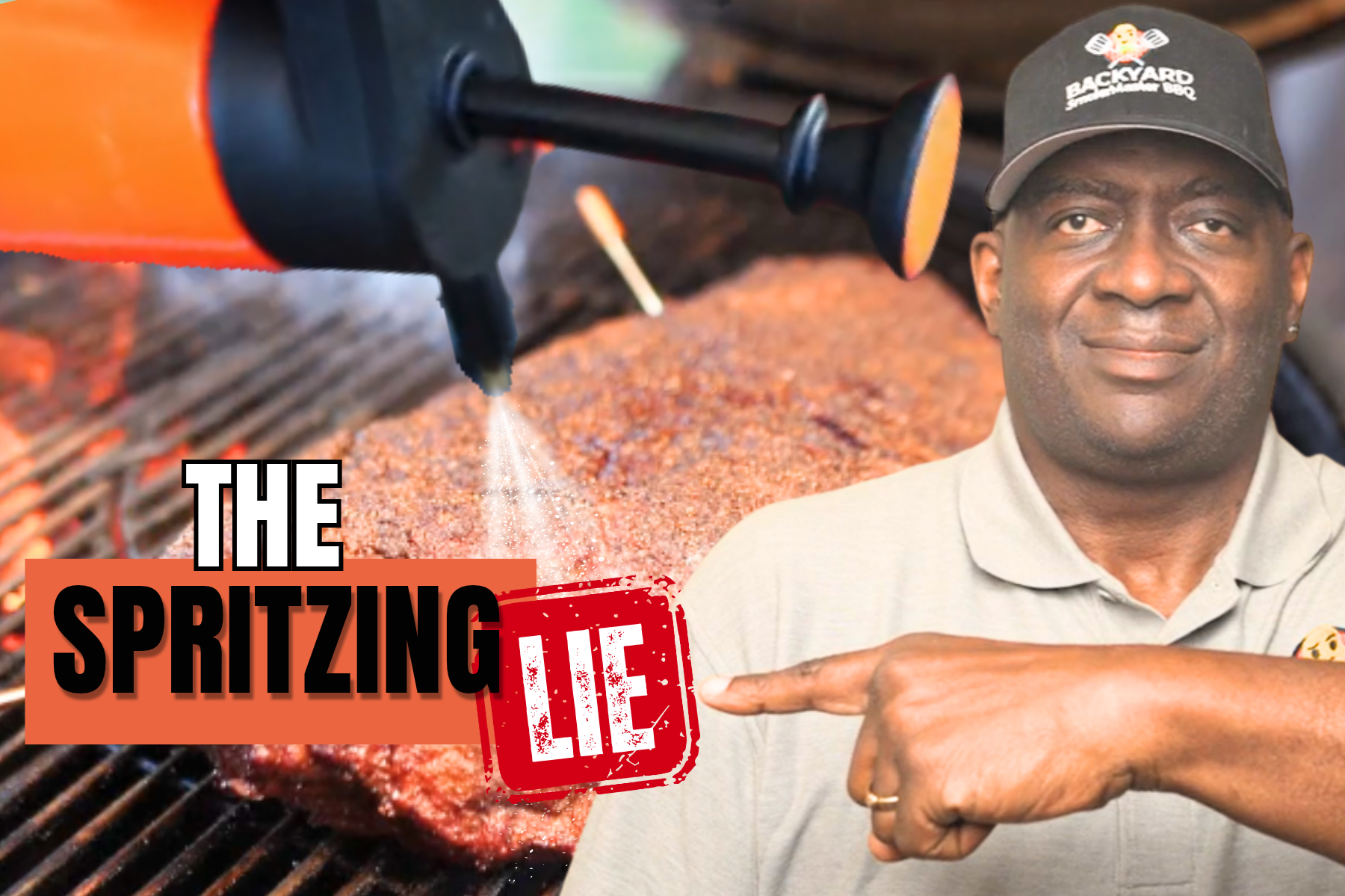
It’s hour four of your brisket cook. You’ve been hitting it with apple juice every 45 minutes, the spray bottle is half empty, and you feel good about it, because moisture going on must mean moisture going in. That’s the part that doesn’t hold up. Very little of that apple juice gets past the surface of the meat. Spritzing does work, though. It just doesn’t work for the reason most of us were told. Episode 113 covers what the spray bottle is really doing, when it helps, when it hurts, when to stop, and why your spritzing plan on a pellet grill should look different from your plan on an offset.
Where the spritzing story came from
Competition teams started spritzing in earnest in the 1990s and 2000s, and what’s popular on the competition circuit tends to trickle down to backyard cooks. Shows like BBQ Pitmasters put pitmasters with spray bottles on camera, and product labels started promising to replenish flavor and moisture. The story we were sold has three parts:
- Long cooks dry meat out from the outside in.
- Spritzing puts that moisture back where it’s escaping.
- Flavored spritzes like apple juice, beer and cider get pulled into the meat for extra flavor and tenderness.
Every part of that sounds right. It’s intuitive, and it makes you feel like you’re doing something. The competition cooks weren’t wrong to spritz. The explanation for why it works was off.
The four things spritzing really does
- It cools the surface. A cooler, damp surface gives the meat a longer window to take on smoke and develop a smoke ring before the surface gets too hot for those reactions.
- It controls how the bark forms. Rehydrating the surface keeps the browning reactions going so the outside doesn’t crust over too fast.
- It helps smoke stick. A moist surface grabs smoke particles more readily than a dry one.
- It builds color. A slower, longer cook at the surface gives you a deeper mahogany bark, and the sugars in a spritz like apple juice caramelize for that signature look.
How bark gets built
Over hours on the smoker, the surface of the meat turns into a small chemistry lab. Proteins, sugars, fats, smoke compounds and rub ingredients all react with each other. Maillard browning starts first. Then those browned compounds, along with smoke and fat, link up into long molecular chains. That process is called polymerization, and it’s what gives bark its structure.
It’s the same thing that happens when you season a cast iron pan. You bake oil onto the metal, the oil molecules bond into a hard, durable layer, and that’s your seasoning. Bark is the meat version: layer after layer of rub, smoke, fat and browned compounds locking together.
Polymerization needs time and the right surface. A surface that’s too dry crusts over fast and leaves you with a thin, fragile bark. A surface that’s slightly damp keeps the chemistry going long enough to build a thick, complex bark. That’s the real reason spritzing helps. You aren’t adding moisture to the meat. You’re giving the bark more time to build.
Why a spritz can’t put moisture back
Raw meat is full of tightly folded proteins. As the meat heats up, those proteins unwind and link to their neighbors, somewhere between 105°F and 160°F depending on the protein. That’s called denaturing. Think of an egg white: clear and runny when it’s raw, white and firm seconds after it hits a hot pan. The protein didn’t go anywhere. It changed structure.
The same thing happens at the surface of your brisket. Once those surface proteins have set, the outside of the meat is far less permeable than it was raw, and a spritz or marinade isn’t going to travel through it in any amount that matters. The moisture you lose during a long cook comes from the inside, as the muscle fibers contract and squeeze water out. A spritz can’t replace it.
So think of spritzing as a bark and color tool, not a moisture tool. Juicy barbecue comes from four things that all happen upstream of the spray bottle:
- Meat selection. Start with a cut that has the fat and collagen for the cook you’re doing.
- Fat content. Rendered fat inside the muscle is a big part of what reads as juicy.
- Temperature control. Cook to the right internal temperature so collagen converts to gelatin without overcooking the meat.
- A proper rest. Resting gives the juices time to settle so they stay in the meat when you slice.
Get those right and you don’t need the spritz to save you. Get them wrong and the spritz can’t.
What to spritz with
- Water: clean and cooling, and it helps smoke stick. It adds no flavor or color. This is what I use. It’s cheap, and it doesn’t change my cook.
- Apple juice: the sugars caramelize for color and add a mild sweetness to the bark.
- Apple cider vinegar and water, 50/50: the acid helps keep the color brighter and adds a light tang.
- Beer: the sugars caramelize for color, and the hops add a little bitterness that cuts through rich, fatty meat. Let it go flat before you fill the bottle, because the foam can clog the nozzle. That solved a mystery for The Correctional Officer, whose sprayers kept giving him trouble.
- Beef tallow or wagyu fat: this isn’t a spritz. Melt it and brush it on, usually right before you wrap or during the rest. It adds beef richness to the bark, keeps the surface supple and gives a glossy finish. Don’t put it in a spray bottle. It’s too thick and will clog the nozzle.
Avoid anything chunky, anything that crystallizes, and anything that’s mostly sugar early in the cook.
The chat had its own list. M Black’s Test Prep spritzes ribs with root beer and uses orange or apple juice on chicken. Monkey Cam brought up Dr Pepper, and ginger ale and diet sodas came up too. Mama Micah wondered about heating artificial sweeteners, and I don’t have an answer on that one. Real Meatstick sometimes spritzes with his injection liquid, and uses Guinness when he’s smoking corned beef. Mama Micah voted for water for a practical reason: it’s the easiest to clean out of the bottle and leaves no smell behind. I agree. Apple cider vinegar left sitting in a bottle is hard to get rid of.
When to start and when to stop
- Don’t spritz before the bark sets. Wait at least 90 minutes, or you risk washing the rub off.
- Then spritz every 30 to 60 minutes. That gives the surface time to climb back to bark-building temperature between sprays. Spritz more often and you destabilize the cooker’s temperature and wash away what you’re building. Spritz less often and the surface can dry out and crust over.
- Stop when you wrap. Spritzing inside butcher paper or foil does nothing.
- Stop in the final hour of an unwrapped cook. Let the bark firm up.
- Skip it on short cooks. For anything under 90 minutes, hot and fast cooks and direct grilling, a spritz only steams the surface.
Smiling Family asked whether waiting for the bark to set means it’s too late to get the smoke benefit. I don’t think it’s too late. The bark has to set first so the rub stays put, and from there each spritz cycle keeps the surface a little tacky so it keeps taking on smoke and building layers.
Match your spritzing to your cooker
- Pellet grill: a pellet grill is a convection environment with relatively dry air, so the surface of the meat dries out faster than on most other cookers. This is where spritzing pays off the most. Don’t be shy with the bottle.
- Offset: burning wood produces water vapor, so the cook chamber is already more humid. Spritzing does less to keep the surface from drying and more for color and smoke adhesion.
- Kettle: it depends on how you’re using it. For direct grilling, don’t spritz at all. For low and slow with the snake method or a two-zone setup, a kettle runs drier than a kamado and more humid than a pellet grill, so spritz about half as often as you would on a pellet grill. Every 45 to 60 minutes is plenty. A kettle loses heat fast when the lid comes off, so spritz, check your probes and rotate the meat in one trip.
- Kamado: a kamado is a sealed, humid environment by design, so spritzing has the least effect here. You can still do it for color and smoke adhesion, but too much may soften the bark and leave it washed out.
- Drum smoker: this includes my Smokeslinger. With a water pan in place, the chamber is already humid, so dial the spritzing way back and treat it like a kamado. Running dry without a pan, treat it more like a pellet grill.
The bottom line: don’t copy an offset pitmaster’s spritz schedule onto your pellet grill cook. Their routine is dialed in for their cooker. Match your spritzing to the cooker you’re on.
Should you spritz during the stall?
A viewer asked whether to keep spritzing through the stall or turn up the heat. I don’t spritz in the stall. If you lift the lid at that point, you’ll usually see liquid already pooled on top of the meat, and that surface moisture is part of what’s holding the temperature down. Adding more is likely to keep you there longer. Here’s what I do:
- Tilt the meat so the pooled liquid runs off.
- Wrap it. I use pink butcher paper because it breathes, so it protects the bark while letting some air through. Foil is popular, especially for ribs, but wrapped tight it can steam the meat and soften the bark you spent hours building.
- If you want to raise the cooker temperature to push through, wrap first.
Spritzing mistakes that hurt your cook
- Over-spritzing. You can end up with a muddy bark, washed-off rub and a soft surface.
- Spritzing too early. It strips the rub before it has a chance to adhere.
- Sugary spritzes too early. Apple juice, beer and other spritzes with sugar caramelize nicely in moderate doses. Start them in the first hour or two of an 8 to 12 hour cook and those sugars take heat the whole time, and caramelizing can turn into burning. Save sweet spritzes for the back half of the cook, once the bark has set.
- Counting on the spritz for moisture. If you believe the moisture story, you may ignore meat selection, fat, temperature and rest, which are the things that keep barbecue juicy.
More from the chat
- Spritzing over open fire: The Correctional Officer hasn’t seen anyone spritz on a Santa Maria grill. That’s direct heat cooking, so I don’t think a spritz would do much there.
- Burgers, continued: The Correctional Officer’s last burgers were juicy but tasted flat. Jeff suggested a seasoning of one part salt, one part black pepper and half a part butter powder. Mama Micah mixes a tablespoon of mayonnaise per pound into the ground beef and says the patties stay juicy at well done. My reminder from the burger episode: the USDA guidance for ground beef is 160°F.
- Smoked potato salad: Mama Micah wondered about smoking the potatoes first. I think that would level it up. Smoke is the one ingredient nobody can copy from inside the house.
- Poll: the apple cider vinegar mix led with 53%, followed by apple juice at 22%, water at 14% and beer at 11%.
- Requests: injection versus brining, grilled vegetables and seafood all came up as future topics. Injection versus brining and marinating became the very next episode.
The recap
- Spritzing doesn’t add meaningful moisture to the inside of the meat.
- It cools the surface, gives the bark more time to build, helps smoke stick and deepens the color.
- Wait until the bark sets, then spritz every 30 to 60 minutes. Stop when you wrap and in the final hour.
- Save sugary spritzes for the back half of the cook.
- Spritz more on a pellet grill, less on an offset or kettle, and least on a kamado.
- Juiciness comes from the meat you pick, its fat, your temperature control and the rest.
Keep the conversation going
What’s in your spray bottle, and what cooker are you using it on? Post it in the Backyard SmokeMaster Society, and tell us whether you change your routine after this episode. It’s free to join.
If this episode helped, share it with a friend who never puts the spray bottle down. If you missed the live show, the replay is up on YouTube, and the audio version is available on your favorite podcast app.
Podcast: Play in new window | Download


Leave a Comment